|
ramé-hart
Newsletter


January
2026 |
| The Surface Science of Modern Building Materials |
|
The desire for buildings that are both functional and beautiful has existed for millennia, shaping everything from ancient temples to modern skylines. Today, the development of new building materials continues to meet this timeless demand in our homes, schools, and offices. Some innovations aim to improve existing technologies, making them stronger, safer, or more efficient. Others go further, unlocking new possibilities that redefine what the structures we live, work, and learn in can do. This article explores two applications that illustrate the transformative power of surface science in modern construction. Self-Cleaning Windows The appeal of glass that can clean itself needs almost no explanation. Not only does it reduce the cost and labor associated with maintenance, but it also improves the longevity of windows and allows for placement of windows and skylights in hard-to-reach locations. Self-cleaning properties can be achieved in two ways, both relying on the contact angle of water with the glass. The first version uses photocatalytic additives to break down dirt and organics. A superhydrophilic surface finish then allows rainwater to spread and form a film that transports debris off the window. Windows using this design have been commercially available since the early 2000s1,2.
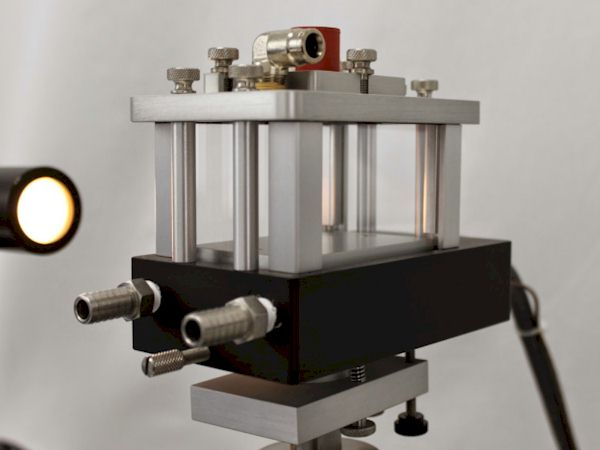
A second type of self-cleaning windows relies on a very high water contact angle. These superhydrophobic surfaces promote water beading. The droplets then capture and carry dirt away as they roll across the surface of the window. These windows can be formed using specialized surface treatments or by the application of a coating. Although they tend to be more cost-effective, superhydrophobic coatings are typically less durable and require reapplication during the lifetime of the window. For both flavors of self-cleaning windows, the contact angle of water is critical for self-cleaning. Many self-cleaning surfaces have been studied using ramé-hart products. Icephobic Materials Another area of research is the interaction between ice and various materials. Ice formation occurs in cold conditions, which can be induced by climate or altitude. When ice builds up, it can threaten the integrity of structures and impact the function of everything from airplanes to power lines. Even small infrastructural elements can have major impacts. For example, in areas where winters are icy and cold, railways can be brought to their knees when road-crossing gates stop functioning because of ice buildup. Two angles of attack have been studied3. One is to minimize the possibility of ice formation in the first place, described as anti-icing. The other is to minimize ice adhesion, described as deicing. Although anti-icing and deicing mechanisms are different, understanding the interfacial characteristics of the surface in question is crucial in both cases. Anti-icing is usually best achieved by surfaces that are superhydrophobic. When water has a very high contact angle with the surface, it improves the likelihood that the droplet quickly rolls off the surface and minimizes the interface where ice nucleation can occur. Deicing depends on the adhesion of ice to a surface, which is predicted by surface energy and contact angle hysteresis. When the surface energy and hysteresis are low, ice will detach from the surface more easily. Because ice formation occurs in specific conditions, it is essential to be able to control temperature when studying the interfacial properties of an icephobic material. The ramé-hart Peltier Environmental Chamber is the only commercially available accessory for contact angle goniometry that can achieve temperatures as low as –50°C and is supported on all ramé-hart instruments. Many researchers also study the effects of humidity on ice formation. The ramé-hart Advanced Chamber offers both temperature and humidity control and can achieve below-ambient temperatures with the use of coolant circulation. The Advanced Chamber is supported on the Model 500 and Model 590.
Creating the building materials of the future depends on a precise command of surface and interfacial characteristics. Our line of instruments and accessories can enable you to study a broad range of applications and conditions. Contact us for more information or for a quote.
Notes |
| NISE 2026 Conference |
| Join us for the 4th International Conference on Nature-Inspired Surface Engineering (NISE 2026), where we explore unique surface properties from nature—like water-repellency in plants and anti-adhesion in insects—and their advanced applications. The conference will be held at the University of Toronto, Canada, from August 10-13, 2026. This multidisciplinary event is the premier venue for sharing the latest advancements spanning physics, chemistry, biology, and materials science related to these multifunctional surfaces. For more details and to register, please visit https://ameriscience.org/nise-2026/. |
| Happy New Year |
| Happy New Year from all of us at ramé-hart instrument co. We sincerely thank our customers for your trust and loyalty over the past 64 years. We remain dedicated to innovating and providing world-class tools for surface science researchers, material scientists, and quality control professionals every day. May 2026 be a good year for you, your family, and your team. |
|
Regards,
Carl Clegg |
|
|