|
ramé-hart
Newsletter


April
2026 |
| How Do You Measure Surface Energy? |
|
The molecules that make up solid materials are bound together by a variety of intermolecular forces. In the bulk of the solid, the molecules tend to be arranged in such a way that these forces are balanced. The molecules at the surface, however, are missing neighbors at the interface. This naturally creates a thermodynamic state in which the surface will tend to interact with its environment. This phenomenon is commonly quantified as surface energy, sometimes also known as surface free energy. Surface energy is a property of a solid surface and is described in terms of dispersive and polar forces. Dispersive forces are naturally present in all matter and arise from statistical fluctuations of electrons in the molecule. Polar forces arise from the shape and composition of the molecule. One of the best ways to explore these forces is by examining how the solid surface interacts with stable probe liquids with well-characterized properties. Because there are multiple forces at play, it is necessary to use multiple liquids to fully interrogate the surface characteristics. Several tools are available in DROPimage Pro and DROPimage Advanced for measuring surface energy. A frequently used tool is the 2-Liquid Tool which, as the name implies, requires contact angle measurements on the surface in question using two liquids. Water and diiodomethane are the ideal liquids to use with the 2-Liquid Tool. Liquid diiodomethane is dominated by dispersive intermolecular forces, while water is dominated by polar interactions. Both liquids are also well-characterized and have been studied for decades.
A common question is whether it would be beneficial to use a liquid representative of the intended application when studying surface energy. This approach is generally not recommended. The properties of water and diiodomethane form an ideal contrast, whereas many other liquids have a mixture of polar and dispersive forces that may not provide resolved surface energy components. Water and diiodomethane are also available in high-purity forms, which improves repeatability. Some labs prohibit the use of diiodomethane due to concerns over toxicity. Although very small quantities are required for surface energy studies, procurement and storage can be a challenge. When diiodomethane is not an option, the recommended alternative is ethylene glycol. 1-bromonaphthalene can also be considered as an alternative if available. Another common question is whether to use the geometric mean (OWRK method) or harmonic mean (Wu method) in the 2-Liquid tool. In general, the OWRK method should be considered to be the default. The Wu method is claimed to be better for low surface energy solids such as polymers. Although two liquids are often sufficient for simple surface energy measurements, it can often be beneficial to measure surface energy with three or more liquids when a high degree of accuracy is needed or to gain additional information about the surface. In addition to water and diiodomethane, glycerol or formamide can be measured for use with the Acid-Base tool. This tool calculates the polar and dispersive components of the surface energy and decomposes the polar component into acid and base components. Understanding the acid/base force composition reveals whether the surface is an electron donor or acceptor, which is relevant when studying adhesion and biomaterial compatibility. Finally, it can be beneficial to verify the surface tension of liquids used for surface energy measurements using the pendant drop method. Water can easily become contaminated and diiodomethane can decompose upon exposure to light. Checking the surface tension is a quick way to verify that your study results will be valid. For more information about the theory behind surface energy, refer to this technical bulletin. Guidance for using all the surface energy tools in DROPimage can be found in the user guide included with each of our instruments. To learn about which of our products can measure surface energy, consult our product matrix or contact us today. |
| Product of the Month: ramé-hart Model 500 |
|
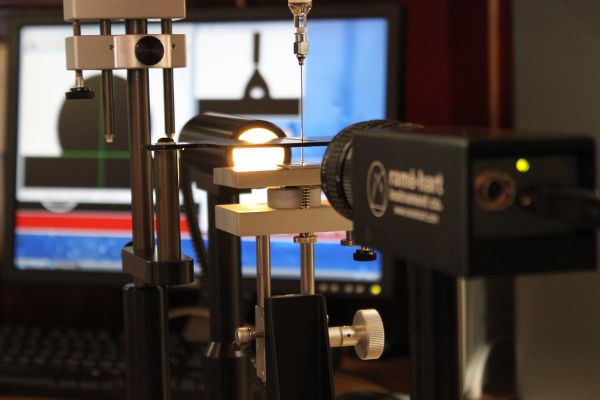
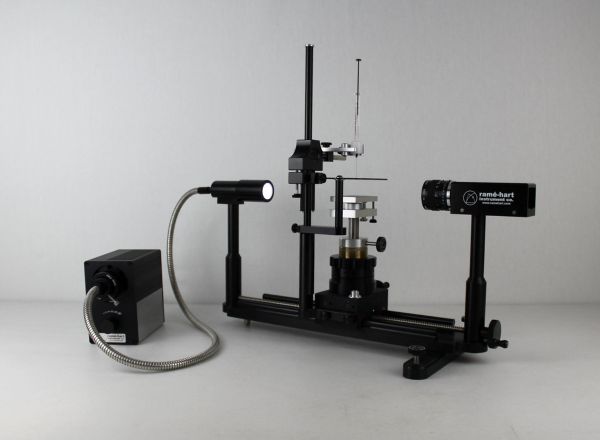
The Model 500 is an Advanced Goniometer/Tensiometer and an excellent tool for a variety of surface science applications, including surface energy. Because it comes with our premium 21-inch optical bench, the advanced 3-axis stage with fine and coarse vertical adjustment, and DROPimage Advanced the Model 500 is our most upgradeable instrument and is compatible with all ramé-hart accessories. All of our instruments come as a turn-key system including a PC with the software pre-installed, a monitor, keyboard and mouse, as well as all necessary tools and cabling for setup. With clear user manuals, setting up and using our instruments is quick and easy. We offer excellent customer service and technical support so you can operate with confidence. |
|
Thank you for your continued business, The ramé-hart Team
|
|
|