Containing Phase Change Materials: Coaxial Fibers
Over the past month, parts of the United States have experienced temperatures above 100°F (38°C). High temperatures are uncomfortable for people, but they can also damage phones, computers, motors, and other temperature-sensitive equipment. Heat dissipation is essential in many applications—but what if excess thermal energy could be captured and stored instead?
One potential solution is the use of phase change materials.
A familiar example of a phase change material, or PCM, is an ice pack. Water or an aqueous solution is sealed inside a plastic pouch and frozen. When the ice pack is placed in a cooler or against the body, it absorbs heat as the ice melts. During this phase transition, the material can absorb a substantial amount of thermal energy while remaining near its melting temperature.
This ability allows PCMs to moderate temperature changes without requiring a continuously powered cooling system. Potential applications include temperature-regulating textiles, buildings, electronics, packaging, and industrial thermal-management systems1,2,3.
The challenge of containing a phase change material
One fundamental challenge is containment. Because a PCM functions by changing phase, it must remain contained both as a solid and as a liquid.
Repeated thermal cycling and associated volume changes can contribute to leakage, migration, or gradual material loss. Some salt-hydrate PCMs may also undergo phase segregation. If components of the melted material separate and do not properly recombine during solidification, the PCM’s thermal-storage performance can become less consistent over time.
Core–shell, also called core–sheath, encapsulation has emerged as a potential solution.
In this structure, the PCM is enclosed within the core of a continuous fiber, while a second material forms a protective outer shell. The shell can be selected or modified to provide properties such as mechanical strength, thermal conductivity, electrical conductivity, or environmental resistance.
The fibrous format provides additional advantages. Fibers have a high surface-area-to-volume ratio, which can support rapid heat transfer. Their small core dimensions may also restrict bulk movement of the melted PCM and help reduce phase segregation.
Forming core–shell fibers through coaxial electrospinning
Core–shell fibers can be produced through coaxial electrospinning. A coaxial needle contains two concentric fluid passages. The core solution is normally supplied through the inner needle, while the shell-forming polymer solution flows through the surrounding annular passage.
A high voltage is applied between the needle and a grounded or oppositely charged collector. When the electrical force overcomes the surface tension of the fluids at the needle tip, a fine compound jet is drawn toward the collector. As the solvent evaporates, continuous fibers containing distinct core and shell regions are formed.
Flow rates, solution properties, applied voltage, collection distance, and needle geometry can all influence the stability of the process and the resulting fiber structure.
Salt-hydrate PCM fibers made with a ramé-hart coaxial needle
In a recent study4, researchers at Oak Ridge National Laboratory used a ramé-hart 100-10-COAXIAL-1814 needle to encapsulate calcium chloride hexahydrate, an inorganic salt-hydrate PCM, inside a polymer sheath.
Salt hydrates can provide high thermal-energy-storage capacity, but they are often more difficult to encapsulate than organic PCMs because of their chemical and processing characteristics. The researchers used the salt hydrate as the fiber core and polyvinylpyrrolidone, or PVP, as the principal shell-forming polymer. Their results demonstrated that coaxial electrospinning could produce continuous core–shell fibers while reducing leakage and improving the stability of the salt-hydrate PCM.
The research group subsequently developed a higher-throughput “co-axial pushing” process that produced much larger core–shell fibers with higher PCM loading. Together, these studies illustrate how concentric fluid delivery can support both small-scale materials research and the development of more scalable PCM-encapsulation methods.
Coaxial needles for core–shell research
ramé-hart has manufactured thousands of prebuilt and custom coaxial, triaxial, and quadaxial needles for researchers around the world.
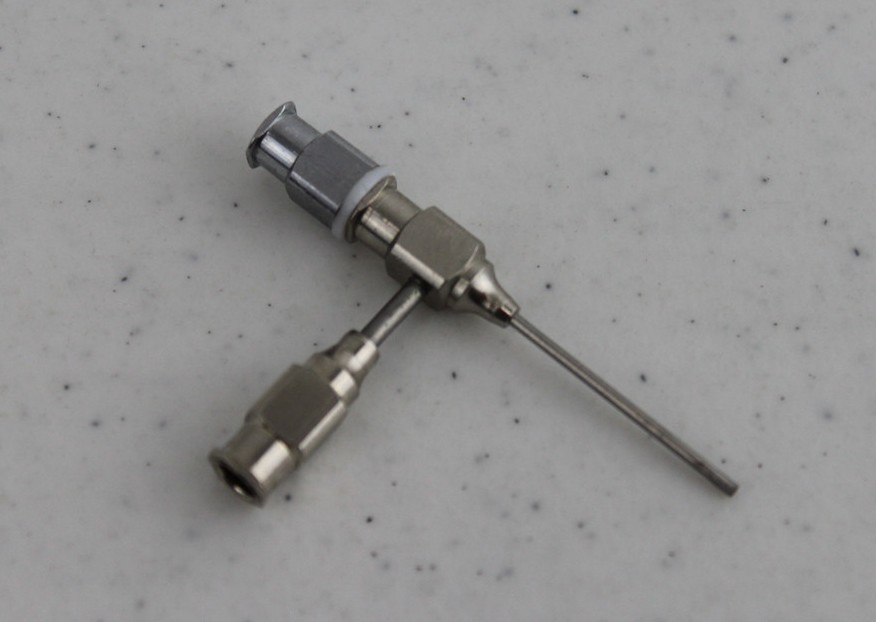
Our coaxial needles are designed to provide adjustable, concentric fluid delivery for core–shell processes. They can be disassembled for cleaning and maintenance, and we offer tubing, fittings, and connection accessories for integration with syringe pumps and other fluid-delivery systems.
Researchers can select from standard configurations or work with us to specify dimensions suited to a particular combination of core and shell materials.
Working on PCM encapsulation, core–shell fibers, or another multiaxial-fluid application? Contact ramé-hart to discuss a prebuilt or custom needle configuration for your process.
Notes
1 Haghighat, F., Hosseini Ravandi, S.A., Nasr Esfahany, M. et al. A comprehensive study on optimizing and thermoregulating properties of core–shell fibrous structures through coaxial electrospinning. J Mater Sci 53, 4665–4682 (2018). https://doi.org/10.1007/s10853-017-1856-1
2 Feng, Wen, et al. "Coaxial electrospun membranes with thermal energy storage and shape memory functions for simultaneous thermal/moisture management in personal cooling textiles." European Polymer Journal 145 (2021): 110245. https://doi.org/10.1016/j.eurpolymj.2020.110245
3 Shuo Wang, Ruifan Wang, Xinran Zhang, Yucheng Li, Hao Ma; Engineering core–sheath phase change fibers for thermal energy storage: fundamentals, fabrication, and smart applications. J. Mater. Chem. A 2025; 13 (45): 38668–38702. https://doi.org/10.1039/d5ta06026e
4 Jaswinder Sharma, Georgios Polizos, Charl J. Jafta, Junbin Choi, Nihal Kanbargi, Reyad Sawafta, Diana Hun, Kashif Nawaz, ChemNanoMat 2026, 12, e202500655. https://doi.org/10.1002/cnma.202500655
Thank you for your continued business,
The ramé-hart Team
World Leader in Surface Science Instruments