Technical Information
Understanding Surface Tension
Surface tension and interfacial tension are central to understanding how liquids behave at interfaces. This page provides a practical overview of the concepts, the forces behind them, and the common measurement methods used in surface science.
What Is Surface Tension?
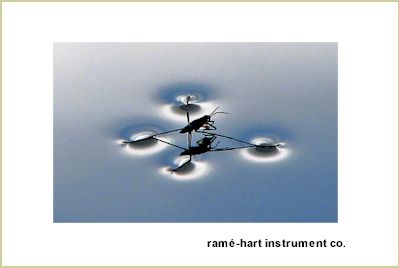
Surface tension is an effect within the surface layer of a liquid that causes the surface to behave in a way that is often compared to an elastic sheet. It is this effect that allows insects such as water striders to stand on water and that causes drops of water to bead up rather than spread out completely.
When a liquid interfaces with a gas, the effect is referred to as surface tension. When the same type of effect exists between two immiscible liquid phases, it is referred to as interfacial tension.
In surface science, both surface tension and interfacial tension are commonly measured in milli-Newtons per meter (mN/m). Equivalent units such as dyne/cm are also often encountered.

Molecular Forces
Surface tension results from an imbalance of molecular forces in a liquid. Molecules in the bulk of a liquid are surrounded by neighboring molecules, but molecules at the surface experience a net inward attraction. This imbalance pulls the surface together.
Higher values of surface tension generally indicate stronger intermolecular interactions. Water, for example, has a relatively high surface tension because of hydrogen bonding. Organic molecules with polar groups are often somewhat lower. Pure hydrocarbons are lower still, while fluorinated compounds are especially low because of the weak interactions that occur at their surfaces.
This is why liquids with different chemistries wet, spread, bead, and interact with solids differently.
Pendant and Sessile Drop Methods
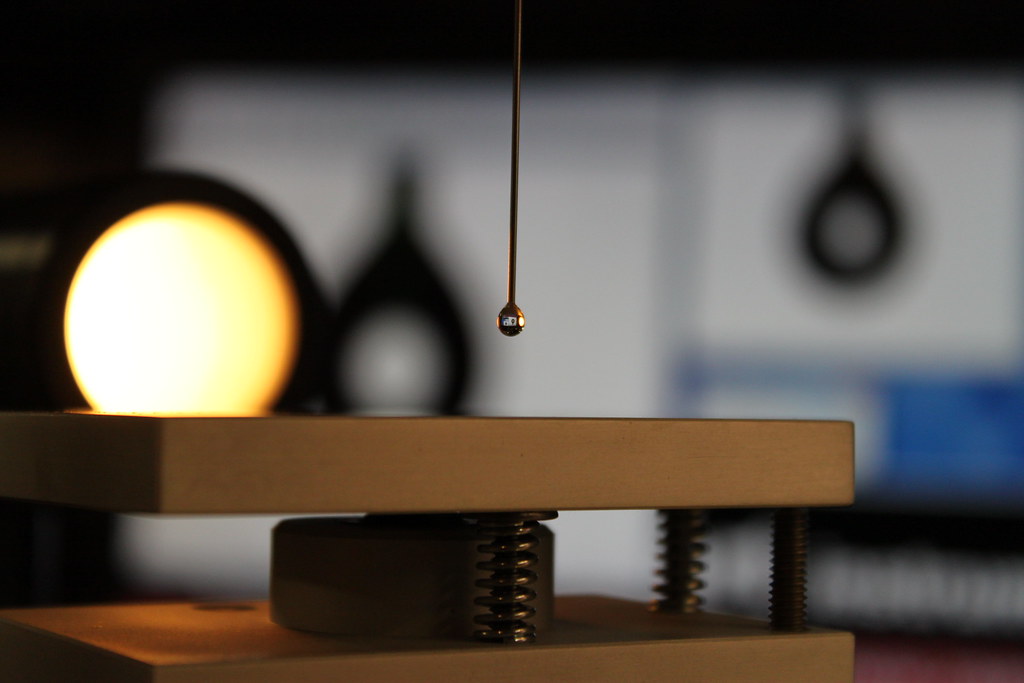
ramé-hart DROPimage uses pendant drop and sessile drop methods to measure surface and interfacial tension. In these methods, the drop profile is captured optically and analyzed to determine the shape of the liquid interface.
DROPimage Advanced applies precise edge tracing to the drop profile and uses the Young-Laplace equation to calculate the surface tension of the liquid. These methods are powerful because they are optical, information-rich, and well suited to many research and industrial applications.
Pendant drop methods are especially common for surface tension and interfacial tension studies, while sessile drop methods are often used when the same platform is also being used for contact angle work.

Interfacial Tension
Interfacial tension is measured when the drop phase and the surrounding phase are two immiscible liquids, such as an oil drop in water. In these cases, the interface is liquid/liquid rather than liquid/gas, but the same underlying concept of interfacial energy still applies.
DROPimage can be used to measure interfacial tension using both hanging pendant drops and inverted pendant drops. This makes it possible to study emulsions, formulations, surfactants, and other systems where liquid-liquid interfaces are important.
Surface Dilatational Elasticity and Viscosity
Related to surface tension is surface dilatational elasticity, which can be studied by the axisymmetric drop and bubble method using periodic oscillatory deformation of pendant and sessile drops or bubbles.
These oscillations can be produced using the Oscillator, allowing researchers to investigate surface dilatational elasticity and dynamic surface behavior in addition to static tension values.
Learn More
If you need help choosing an instrument or software configuration for surface tension or interfacial tension measurement, our team can help you identify the right system for your workflow.